Fermentation Tanks Compared: What Matters Beyond Volume
Litres are the easiest number to compare and the least useful on their own. Two 1,000 litre fermenters can behave like completely different vessels once working volume, headspace, jacket coverage, cone geometry and bottom design are taken into account. This comparison sets out the questions that separate a tank that suits your brewing from one that merely fits your ceiling.
Key takeaways
- Total volume is a shell dimension; the useful figure is working volume, commonly around 75 to 85 per cent of the tank.
- Jacket coverage on body and cone, not the chiller size alone, decides how fast a batch can be cooled after fermentation.
- Cone angle and bottom design govern how cleanly yeast and dry-hop material leave the tank.
- Headspace has to carry the krausen of the strongest beer you intend to brew, which is rarely the beer in the first recipe book.
Working volume, total volume and the difference nobody quotes
Hermann Biological Engineering has spent 23 years designing vessels of this kind, and the first thing its published size list shows is that a fermenter is sold by its total volume while a brewer lives inside its working volume. Fill a 1,000 litre tank to the brim and the first vigorous fermentation will push foam through the blow-off arm and onto the floor. Most brewers plan between 75 and 85 per cent fill, so that same tank realistically holds 750 to 850 litres of fermenting beer.
The gap is not waste; it is headspace. It absorbs the krausen of a high-gravity ale, it keeps the beer surface away from the tank top during a dry-hop addition, and it gives the carbonation step room to move. When you compare two suppliers, compare the volume they recommend you brew rather than the volume the shell happens to hold.
Jackets: where the cooling actually sits
A tank with a single body jacket and no cone jacket is fine for ales in a cool room and awkward for anything else. Cooling applied only to the cylinder leaves the cone, where yeast settles and where the liquid is deepest, warm. That is where diacetyl rests drag on and where the harvest gets sloppy.
Zoned jackets solve the second problem: separate circuits for the lower body, upper body and cone let the control panel hold a steady temperature through the active phase and then crash the whole batch at the end. Ask how many independent zones the jacket set gives you, how they are piped, and what the glycol flow rate and pressure drop are at the design temperature. A single circuit that loops every zone in series is a different tank from one with three separate circuits, even though the shells look identical.
The chiller has to match the jacket, not the other way around. A generously jacketed tank attached to an undersized chiller will still crawl through a crash cool, and the first hot month of summer will expose it in front of paying customers.
Cone angle, dish bottom and the shape of the tank
Fermenters are normally conical because a cone concentrates yeast in a small area where it can be dumped through a bottom valve. A steeper cone, in the region of 60 degrees from horizontal, helps dry yeast and hop material slide instead of clinging to a shallow slope. A shallower cone is cheaper to build and harder to clean.
Bright tanks are a different argument. They store finished beer under pressure, so they are often built with a dished bottom that handles pressure more evenly and drains through a fitted standpipe. Comparing a conical fermenter with a dish-bottomed bright tank on volume alone misses the point: they do different jobs and take different pressures.
Also worth asking about: whether the bottom outlet is a single valve or a yeast-collection arrangement, whether there is a sample valve at a height you can reach without a ladder, and whether the manway and dry-hop port are placed where a person can actually use them. A look through the supplier's published brewhouse and tank listings will show which of those options are standard and which are extras.
| Design point | What it changes | Question to ask |
|---|---|---|
| Working volume | How much beer a tank actually holds | What fill percentage do you design for? |
| Jacket zoning | Speed and evenness of cooling | How many independent circuits, and how piped? |
| Cone angle | Yeast and hop removal | What is the cone angle from horizontal? |
| Headspace | Whether strong beers fit | What is the headspace above working volume? |
Why volume comparisons mislead on a running plant
A single tank tells you nothing about a brewery. What matters is how many times a tank can turn in a month, because that decides whether your brewhouse capacity is matched by fermentation capacity or wasted waiting for one.
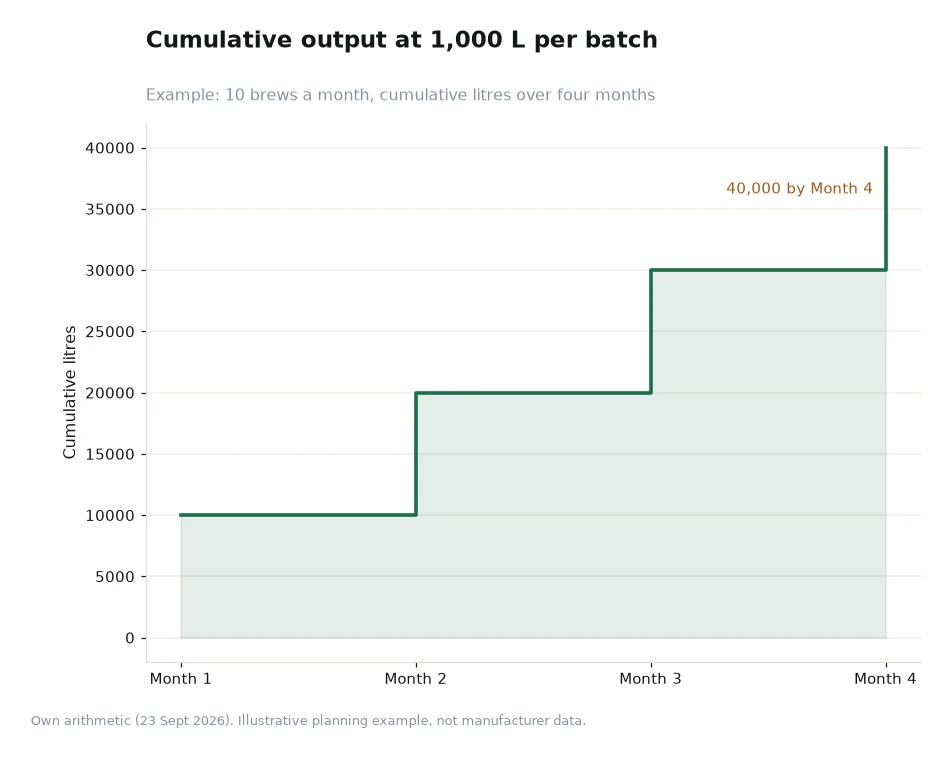
The chart below makes the numerator visible. It assumes a 1,000 litre batch size and 10 brews a month, then shows cumulative litres over four months: 10,000, 20,000, 30,000 and 40,000. That is a plant running at its design rate, with a tank turning roughly twice a month at a two-week fermentation and conditioning cycle.
Worked example: how fill level changes the same four months
Here is the same plan run at a realistic fill level. Assume one 1,000 litre fermenter, a working volume of 85 per cent, 10 brews a month and a two-week cycle from pitching to packaging. The usable volume per brew is 1,000 multiplied by 0.85, which is 850 litres.
Ten brews a month therefore produce 8,500 litres rather than 10,000, and four months give 34,000 litres against the 40,000 litres shown on the chart. The 6,000 litre difference over four months is the headspace nobody counts when they buy on shell volume. If that shortfall matters commercially, the options are a second tank, a faster cycle, or a larger vessel ordered with the fill percentage written into the specification.
Run the same sum the other way to size a tank from a target. A brewery that wants 12,000 litres a month from 10 brews needs 1,200 litres of saleable beer per brew. At an 85 per cent fill that calls for a working shell of about 1,412 litres, so a 1,500 litre fermenter is the honest order rather than a 1,200 litre one.
Frequently asked questions
Should I buy one large fermenter or two smaller ones?
Two smaller tanks cost more in fittings, valves and floor space, but they let you brew two styles at once and they keep the plant running when one tank is being cleaned or repaired. One large tank is cheaper per litre of capacity and simpler to cool. Most small breweries end up with several mid-sized vessels rather than a single showpiece.
Do I need a cone jacket if I only brew ales?
A body jacket can hold ale fermentation temperatures in a temperature-controlled room, so a cone jacket is not strictly necessary. It becomes valuable when you want to crash cool quickly, harvest cleaner yeast or brew lagers and cold-conditioned styles. If your first-year plan includes any of those, order the jacket now rather than rebuilding the tank later.
Specify the tank, not just the litre figure
Write the specification as a list of behaviours rather than a volume: fill percentage, jacket zones, cone angle, bottom outlet type, pressure rating and port positions. Send that same list to hem craft beer equipment and to any other supplier you are considering, and compare the answers line by line. Suppliers who answer in detail are describing a vessel; suppliers who answer only in litres are describing a price.
Once the tanks are on the floor, the paperwork matters as much as the steel. Ask for the pressure-test record and the serial number on every data plate, and keep the inspection documentation with the order file; the equipment catalogue pages name the vessel families and sizes, while the contact desk can confirm details for a specific order. The published warranty on the brand's tank accessories and electronic components runs 6 years against manufacturing defects from the factory, used within scope, and a claim is far easier to make when the serial numbers are on file.
Figures in this article come from the manufacturer's own website, read 23 Sept 2026, including the 6-year warranty wording and the published vessel size range; the cumulative and fill-level calculations are this article's own arithmetic with assumptions stated in the text. Details: [1]