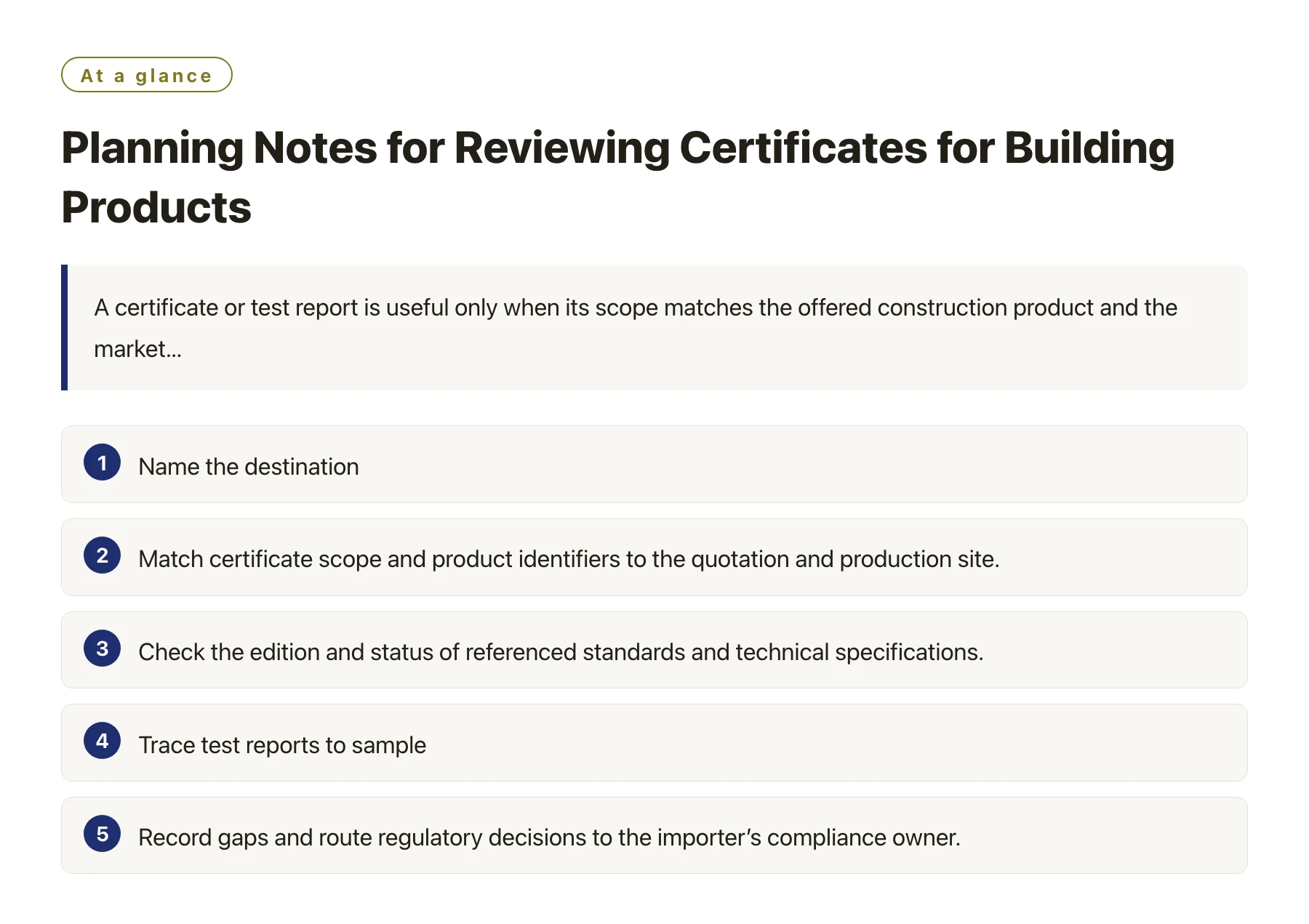
A certificate or test report is useful only when its scope matches the offered construction product and the market where it will be used. Identify the product family, manufacturer, factory, intended use, applicable technical specification, document issuer, and validity before accepting a file as evidence. Keep declarations, test reports, management certificates, and marketing claims distinct. A document check can flag gaps, but a qualified compliance owner must decide which legal requirements apply.
Key takeaways
- Name the destination, product use, model, factory, and applicable technical route.
- Match certificate scope and product identifiers to the quotation and production site.
- Check the edition and status of referenced standards and technical specifications.
- Trace test reports to sample, method, results, issuing body, and production scope.
- Record gaps and route regulatory decisions to the importer’s compliance owner.
Build a document register before production so unresolved evidence does not surface at shipment release.
1. Identify the exact product and destination
Start with the product name, model, material, dimensions, finish, manufacturing site, and intended construction use. Establish which country or region will place the product on the market and who acts as manufacturer, importer, distributor, or project specifier. The same item can face different documentation requirements in different markets or uses. Avoid asking for a generic “certificate” before clarifying what claim or obligation the document is meant to support.
Create a product-to-document matrix with SKU, factory, market, requirement, requested evidence, owner, and status. Separate performance, safety, chemical, environmental, and management-system evidence. A factory’s ISO management certificate, for example, does not establish that a particular board, tile, fitting, or insulation product meets its project requirements.
2. Classify the document before reviewing it
Determine whether the file is a declaration, test report, inspection report, certificate of conformity, factory quality certificate, or supplier statement. These documents serve different purposes. A laboratory report records tests within a stated scope; a product certificate may indicate third-party assessment against specified criteria; a management certificate applies to an organization’s system. Do not treat their titles as interchangeable proof of product compliance.
Record the issuing organization, document number, issue date, expiry or surveillance status where applicable, referenced standard, product model, manufacturing address, and any annexes. Check whether the document is complete and legible. A missing page or translated summary may omit limitations, sample identity, test conditions, or the exact factory covered.
3. Match scope, model, and production site
Compare the document’s product scope with the supplier’s quotation and approved specification. Verify model names, dimensions, composition, finish, variants, and manufacturing site. A report for a similar product may not cover a different resin, thickness, coating, connection, or supplier location. If a product family is grouped under one report, request the issuer’s scope explanation and the basis for including the offered variant.
Ask how the factory connects production lots to the certified or tested product. Review labels, batch records, and any required mark or declaration reference. When a document names a different legal entity or address, ask whether it is the actual producer, parent company, exporter, or certificate holder. Resolve the relationship with traceable evidence rather than assuming a name difference is either harmless or proof of invalidity.
4. Check the standard and regulatory route
For a construction product, identify the technical specification or assessment route that applies to its category and intended use. Confirm the relevant standard edition, publication or citation status, assessment system, and any transition rules. Do not rely on a standard number alone: a withdrawn edition, draft, voluntary test, or foreign standard may not satisfy a market requirement. Ask the compliance owner to confirm the route using current official sources.
The European Commission explains that the 2011 and revised 2024 Construction Products Regulations will coexist while product families move to the updated framework; applicability depends on the relevant harmonised technical specification and transition. Check the current status for the specific product family rather than assuming that all declarations changed at once. [1]
5. Review test evidence and limitations
For each report, record the sample description, source, date, test method, conditioning, laboratory, results, units, uncertainty or stated limitations, and conclusion. Confirm the sample resembles the product being ordered and ask whether the report is type testing, factory production control evidence, or a one-off test. If a result is near a limit or a test method differs from the specification, refer it to a qualified technical reviewer.
Check whether the laboratory and any certification body are accredited or recognized for the exact scope when the applicable scheme requires it. Verify status through the relevant official directory or issuing organization where possible. Accreditation for one method or material does not automatically cover another. Store the verification date, URL, person checking, and result in the register so later reviewers can repeat the check.
6. Verify declarations, marks, and accompanying information
Compare declared product performance with the project’s specified characteristics and acceptance criteria. Check the declaration language, product identification, manufacturer, intended use, technical specification, assessment route, and responsible signature or electronic reference as required. Confirm that a required mark is applied to the product, packaging, or accompanying document in the format expected for the relevant market.
Review installation, handling, maintenance, and safety information where required. Check labels and instructions against the approved product and local language obligations. A declaration with “not declared” values or missing performance characteristics may be acceptable in one context and insufficient in another. Do not infer project suitability from a mark alone; the design or compliance owner should compare the declared performance with the site specification.
7. Resolve discrepancies before ordering
Create a discrepancy log with document reference, issue, affected model or lot, risk, owner, due date, and resolution. Common gaps include unmatched product codes, missing annexes, expired scope, altered factory details, an unrecognized issuer, unclear report samples, and declarations that omit requested properties. Ask the supplier for the original complete file or a written explanation linked to the relevant product.
Set a decision gate before production or shipment. If evidence is essential and still missing, state whether the order must wait, a substitute can be reviewed, or a qualified reviewer may approve a documented deviation. Avoid changing a certificate, label, or report to fit a buyer request. Maintain the original file and any corrected version with dates and a clear supersession note.
8. Keep the evidence current through delivery
Before production, confirm that the supplier will notify the buyer about changes to material, factory, product design, test method, or applicable standard. Require a new review when a change could affect declared performance or document scope. At final inspection, compare the actual item and marks with the approved records, then retain the inspection report, packing documents, and shipment references together.
The buyer, importer, designer, and supplier may own different compliance decisions; assign each explicitly. Buyers arranging wholesale construction materials from China can maintain a shared document register across suppliers, but each product still needs its own scope and market review. Close the record only when the responsible owner has resolved open requirements and shipment evidence is linked to the delivered lot.
Sources
Frequently asked questions
Does a factory ISO certificate prove its building product complies?
No. It concerns the management system within its stated scope. Product compliance requires evidence appropriate to the product, intended use, destination, and applicable technical route.
Can a certificate for one model cover a similar product?
Only if its formal scope includes the offered model and production site. Compare materials, dimensions, variants, and annexes, then ask the issuer or compliance owner to confirm coverage.
How should importers handle an expired or incomplete certificate?
Record the gap, identify affected products and decisions, and request a current complete document or issuer confirmation. Hold any decision that depends on unresolved mandatory evidence.
Do all construction products follow the same CE document process?
No. The relevant route depends on product family, intended use, harmonised technical specifications, and applicable transition rules. Confirm the current route with a qualified compliance owner.