The Creators Side: Who Builds the Characters
Every listing on an adult character platform was written by someone, and the differences between listings are usually differences between authors rather than differences between ideas. The platform's own navigation gives that work a front door — Characters, Memories and Creators sit side by side — and the attribution line on a trend card, carrying 7.1K favourites at a conversion of about 0.029% on 24.3M views in one example, is the visible result of it.

Key takeaways
- Authors publish four things at once: a premise, a personality, a tag set and a description that has to convert a click into a first message.
- Attribution compounds. A reader who liked one listing from an author is cheaper to win over on the next one.
- Tags are the publishing decision with the largest effect, because they decide whether a card enters a shortlist at all.
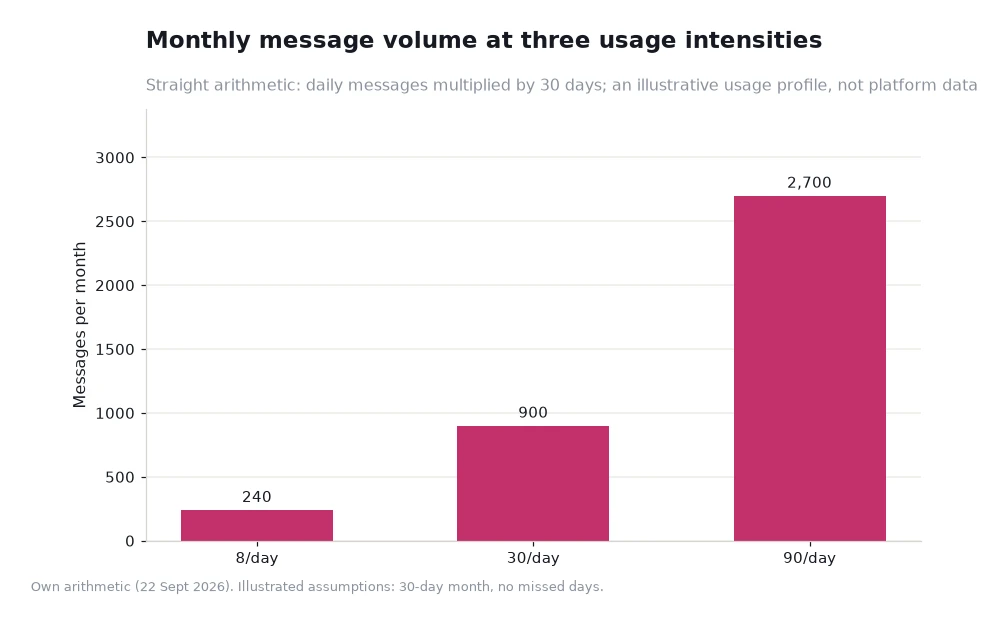
- Scale is easier to picture in messages: 8 a day is 240 a month, 30 a day is 900, 90 a day is 2,700.
What publishing actually involves
The premise is the first deliverable and the one that gets all the attention. It is also the least durable advantage, because a good premise can be copied in an afternoon. The personality that sits underneath it — how the character responds under pressure, how quickly it warms up, what it refuses — is harder to imitate and shows up only after a few exchanges.
The tag set is the third deliverable and the most practical. A listing's tags decide which searches it can appear in, so a well-written card with the wrong labels competes for nothing. This is the step where authors lose the most reach without ever noticing, because the loss is invisible from the author's side of the interface.
The description is the fourth and the one a reader judges first. It has a single measurable job: convert an impression into a conversation. Descriptions that name a situation and a register do that. Descriptions built from mood adjectives tend to collect views and very few favourites, which is a pattern visible in the counters on any trend card.
Attribution and the compounding effect
Attribution lines turn a catalogue into a body of work. For a reader, they answer the question a ratio cannot: whether the voice you liked on one listing is available on others. For an author, they convert a single success into a reason to be followed, and following is the cheapest discovery mechanism on the platform.
The compounding is easy to see in the numbers. If one listing brings a reader in, the second listing from the same author starts with prior trust rather than from zero, and the third starts with more. That is why authors who publish consistently tend to grow faster than authors who publish one strong listing and stop.
There is a second practical reason to keep the author's view in mind while browsing: it tells you which disappointments are worth acting on. A listing that misses on register but comes from an author whose other work you rate is still worth a second title. A miss from a name you have never seen again is simply a card that was not for you. Treating every miss as a verdict on the catalogue is how readers end up switching platforms when all they needed was a better shortlist.
One note for anyone writing rather than reading. Publishing is a series, not an event. The second listing is easier than the first because the description formula, the tag habits and the register have already been decided, and authors who treat the first card as a draft of the second improve faster than those who rewrite the same card repeatedly.
| Element | What the author controls | What the reader gets |
|---|---|---|
| Premise | The situation and the hook | A reason to open the card at all |
| Personality | Pacing, warmth, how replies shift | Consistency across a long thread |
| Tags | Which searches the card can appear in | Whether the card is findable without a name |
| Description | The promise made before the first message | An accurate expectation of the register |
| Attribution | The name attached to the listing | A way to find the author's other work |
Worked example
Two calculations show the scale an author is working at. The first uses real counters: a card with 24.3M views and 7.1K favourites converts at about 0.029%. Now apply that ratio illustratively to a smaller listing: 50,000 views at the same 0.029% yields 50,000 × 0.00029 = 14.5, so roughly 15 favourites. The same card at 200,000 views would reach about 58 favourites.
The second calculation is about retention rather than reach. Using the illustrative intensities charted below, a reader at 8 messages a day sends 240 messages a month, a reader at 30 a day sends 900, and one at 90 a day sends 2,700. Because a long thread depends on a personality that holds, the heavy readers are the ones an author's consistency is tested by.
Put the two together and the publishing lesson is simple. Reach is set by tags and launch timing, but durability — the thing that produces favourites rather than views — comes from whether the personality survives week three.
How to read a catalogue as authored work
Start from the Crushon front page at https://crushon.ai/ and use the Creators entry rather than the browse feed. Following one author whose register fits is faster than filtering 20 cards a week, and it makes the Thursday reset irrelevant to you, because the people you follow do not disappear when the slate changes.
Two habits help on the reader's side. Check the attribution on any card you like before you close it, so you can find the author again. And when a listing disappoints, look at whether the description or the tags were the problem: in most cases the tags brought you to a card that was never meant for your shortlist, and the correct response is to adjust your own filters rather than to judge the author. The character search view and the weekly rankings both expose author names, which makes that check a two-second habit.
Frequently asked questions
Can one author publish several characters?
Yes, and it is common. Following an author is the fastest way to build a shortlist, because the second listing inherits the trust the first one earned.
What matters most when a listing is published?
Tags, because they decide whether the card reaches a shortlist at all. A strong description cannot compensate for a label set nobody searches.
Why do some cards collect views without favourites?
Usually a mismatch between the promise and the register. The card is opened on the strength of its tagging and abandoned once the description's promise is not kept.
Follow the author, not the ranking
Pick one listing you liked, note who wrote it, and read their other work before you return to the browse feed. That single habit replaces weekly browsing with steady discovery.
Keep a short list of two or three authors and revisit it monthly. It is a smaller, calmer way to use the platform — and a reminder that every card has a person behind it. Material here is for readers aged 18 and up.
Data and sources: platform navigation and attribution lines, trend card counters and the 20-card weekly slate, all read on 22 Sept 2026[1]. The favourite ratios used above are arithmetic on published counters; the 50,000-view and 200,000-view examples and the monthly message volumes are illustrative assumptions, not platform data. Written for adults 18+.